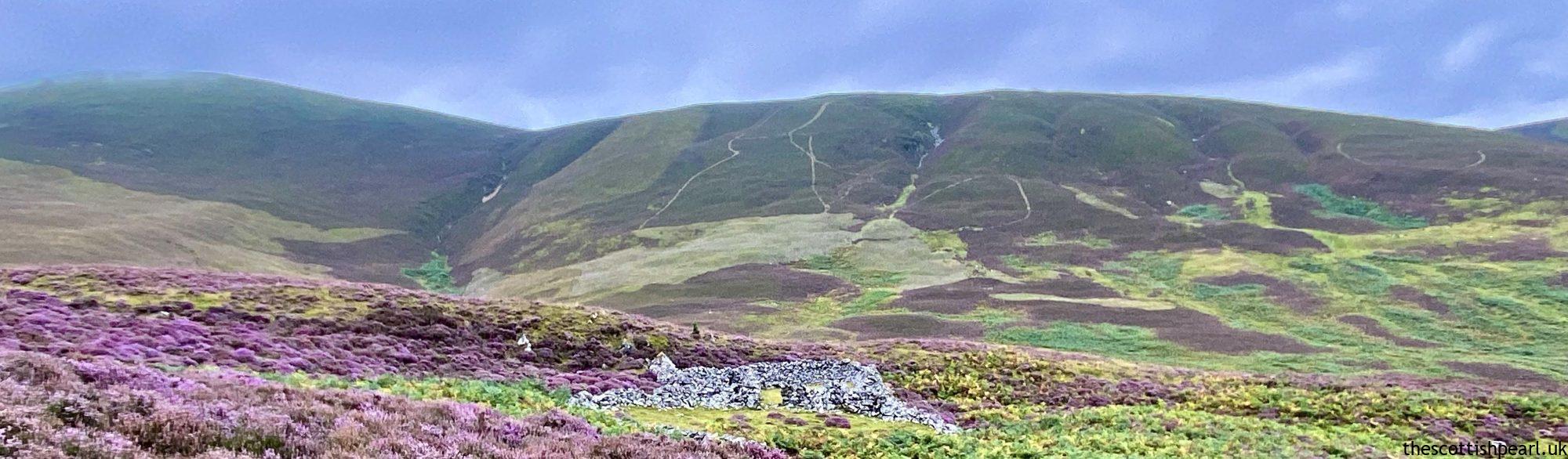
Another overcast day and another adventure on the Isle of Lewis.
Our next stop was the ruins of Dun Carloway. We were heading to see a historic roundhouse known as a broch.
As we got closer we could see the structure in the distance. It looked like a stone beehive. As we did the climb towards the ruins, l looked up information about this broch. I found the following on the Visit Scotland site:
At Dun Carloway, we can get an excellent cross-section of a broch – a type of structure found only in Scotland. At 9m tall it still stands close to its impressive full height. The broch was probably constructed about 200 BC. Broch-building ceased around AD 100, but they may have continued in use. Evidence from excavations suggests Dun Carloway may have been used until about AD 1000. It’s also said to have been used as a stronghold by members of the Morrison Clan during the 1500s.
Visit Scotland
I had no idea that these were that old, tracing back to 200BC. It is truly amazing.
Storyboard about Brochs
I was quite taken aback by the size. I wondered about the challenge of building it. There were a lot of stones in this structure and it was built on quite a hill. It was extraordinary.
We ventured inside to get a better feel of the place. It was very windy but once inside there was a sense of calm. The difference was striking. I could see for miles. I was left in wonder about what life would have been like living there.
In a recent post, I wrote about the building of the Museum of Edinburgh. I love old buildings and so I was compelled to give it its dues. In this post, I touch on the treasures inside the museum. The museum is the primary location for the Bonnie Capital’s local history.
Architectural Artifacts Outside
Before entering inside I like to stroll outside. I love architectural artifacts and many can be found in the courtyard.
It is worth taking a stroll to examine the collection. It certainly stimulated my imagination.
Treasures on Display Inside
Climbing the stairs to enter the museum
Inside the museum, there are many collections representing the city’s rich history.
Current Exhibition: Caribbean Life in Edinburgh
Entrance to Caribbean Life in Edinburgh Exhibition
The current exhibition (running until Feb 2023) is that of Caribbean life in Edinburgh. The exhibit is a result of a collaboration with the Edinburgh Caribbean Association.
On show are cultural displays with links to Scotland.
Scottish Names on the Caribbean Landscape
It is a lovely reminder of the city’s cultural diversity which is an integral part of the city’s overall history. A wonderful step in unveiling the modern-day history of the city.
Old Town Treasures
The Museum does a great job of telling the story of the Old Town.
Model of Edinburgh, the walled city.
I was fascinated by the architectural models of the old walled city. Of course, I would be, they are, after all, mini buildings 😄 I was particularly taken by the model of early 16th-century Edinburgh. The model had the following caption:
The model was made to show the position of the Flodden Wall. The English defeated Edinburgh at the Battle of Flodden. in 1513. Soon afterwards, a defensive wall – known as the Flodden Wall- was built around the city to protect it from further attack. The stretch of water called the Nor’Loch shields Edinburgh’s north side. The artificial lake was drained in 1821 to become Princes Street Gardens.
There are also great models showing the road from Cowgate to the Castle. I was intrigued as I tried to make out the Museum of Edinburgh and Tolbooth buildings.
There are also many storyboards telling the story of the city and its people.
I also loved the other models, illustrations and paintings.
New Town Treasures
The historical journey is also well represented for the New Town.
Again, there are informative storyboards and maps of the New Town.
Other Treasures
You can easily spend hours at the museum. In addition to the above, it has amazing collections of Scottish silver, glassware, clocks, pottery, porcelain and more! There is even a display of the archaeological findings from the current Tram construction.
Have you been to the Museum of Edinburgh? If you have not had a chance yet, I recommend a visit.
Museum of Edinburgh on Canongate
You cannot miss it with its yellow and red façade located on Canongate (The Royal Mile) in Old Town, Edinburgh. The city’s historic treasures of yesteryear are housed in this iconic building, the Huntly House.
The Building Exterior
So even before perusing the city’s historic artifacts inside, the building and grounds are worth exploring. It is a true wonder. I love historic architecture and the museum of Edinburgh definitely delivers. As a result, this post is dedicated to the building. The treasures inside the museum will be described in a separate post.
The Museum building, also known as the Huntly House, is a typical 16th-century built Canongate house. At first glance, you may think that the museum is only the yellow and red plastered building on the Mile, when in fact it is a consolidation of three. An interesting overview of the history is described below.
Huntly House, one of the best old buildings in the Old Town, is a group of 16th and 17th century dwellings, rising to three storeys, surrounding an internal courtyard. Huntly House was built or remodelled in 1570 for the Achesons, and was used by the Gordon Earls and Marquises of Huntly, and later became the headquarters of the Incorporation of Hammermen (metalworkers), who had the architect Robert Mylne extend their building. The building was later divided and in 1851 where 323 tenants were listed as living here. The property went to the City of Edinburgh in 1924, and the building is now the Museum of Edinburgh
The Castles of Scotland
Old Postcard of Huntly House (source: Castles of Scotland)
Such rich history. I am glad that the city saved, restored and repurposed this wonderful structure. I was fascinated by the above old photo I found. I found several other old photos on the Canmore site.
East Entrance
If you do visit, do take the time to walk around the outside including walking down Bakehouse Close which is located west of the building.
Walking Bakehouse Close
As I walked the Close I certainly got a better feel for its size and structure. The museum was more like a series of inter-connected buildings forming a complex, which explains the “maze” inside. The courtyard was also quite delightful.
The Courtyard
The Building Interior
Upon entering the museum, you are thrown into a historic maze. You cannot help but be intrigued.
You can easily spend alot of time just figuring out the building layout. While exploring, remember to look up. The beams are amazing.
Carved Beams
Apparently, the beams were taken from Pinkie House in Musselburgh, and the wood panelling in the museum is from several old houses from the Canongate area.
The moulded fireplaces and doors were also extraordinary.
Interior door/gate
These too have been salvaged from other Edinburgh townhouses of the same period. How wonderful that they have been saved and displayed in this manner.
Fireplace
The windows are also well restored.
Many are 12-pane glazing timber sash windows with great views of the Royal Mile.
The entire building, inside and out, is a total treasure.
Roadtrip! Last month I hopped onto a bus and decided to make the trip to Inverness. It had been far too long since I last visited the Highlands. It was wet, grey skies and perhaps terrible weather to go exploring. I did not care, I was fixated on heading north and just like that my mini adventure started.
In between the rain showers and my periodic squinting, I savoured the scenery.
The ride through Perthshire,
Perthshire, the gateway to the Highlands. There is something about seeing that unspoiled and majestic mountain range. The clouds made it even more dramatic. Really? Who can tire of such views? Not I.
I must plan to stay sometime. I will add a visit to my 2023 goals!
Green Park Hotel overlooking Loch Faskally
As we crossed the River Tummel there was a great view of the Green Park hotel.
Ruthven Barracks
As we continued the drive to Inverness, I had not noticed the ruins near Kingussie before.
I have since learned that the ruins were Ruthven Barracks.
Ruthven Barracks were built by George II’s government in the early 1700s after the failed Jacobite uprising of 1715. The troops stationed there were to maintain law and order. The location was clearly strategic.
Sheep grazing on the mountainside
The scene of sheep grazing on the hillside increased as we got closer to Inverness. I have also since learned that this is commonplace in the Highlands and Western Isles.
After a 3-hour ride, I finally arrived at the Highlands capital city. Such a pretty city.
A visit to the centre led me to the castle. The castle always looks great -even with all the maintenance work currently being carried out.
Inverness Castle
And of course, a trip to Inverness would not be complete without checking out the town hall. The jewel of the city centre.
Inverness Townhall
Although I had planned to continue my journey further north to Ullapool, I took the opportunity to explore both the centre and the canal.
Caledonian Canal in Inverness Walking the city centreAye, The Local Monster and Celebrity
I even had the time to walk to the Ness Islands where I met the local celebrity! What a great start to my Northern adventure.
When in Edinburgh, how often do you stroll in Dean Village?
It’s my quick escape; well that and walking along the Water of Leith Walkway. I always enjoy walking along the river, especially from Stockbridge to the Village. It is so therapeutic.
The Water of Leith Walkway Stockbridge entrance
When you enter the Walkway from Stockbridge, there is a lovely seating area. I can never turn down its invitation to sit and take in the sounds of the river. It is my coffee break stop.
The path continues to Dean Bridge. Regardless of the month or season, it is always green.
As you approach the old mill, you come across a series of brooks.
A few weeks ago I shared a post about Pittencrieff Park in Dunfermline. What was visibly absent from that post was any mention of the Abbey 😊. I just thought it would be better to share my time spent at the Abbey in a separate note. Hence this post.
The Abbey is close to the City Chambers. If you are anywhere near it, it is worth a visit.
Burial groundsThe Abbey and the Burial grounds
As you walk through the centre of town, now city, there is a path that runs through the Abbey’s burial grounds that leads to the majestic structure of Dunfermline Abbey.
When strolling the grounds, you can’t help but wonder how many historic figures would have walked these paths. It has had an amazing past.
Front Entrance, Dunfermline Abbey
A little look into the past you find that: “The foundations of the original church evolved into the Abbey in 1128. Dunfermline Abbey went on to control four burghs, three courts of regality and a large portfolio of lands. A total of eighteen royals, including seven Kings, were buried there from Queen Margaret in 1093 to Robert Stewart, Duke of Albany in 1420. During the fight for Scottish Independence from English rule, between 1296 and 1329, Robert The Bruce had insisted as early as 1314, to be buried in the royal mausoleum in Dunfermline. Robert The Bruce (reigned 1306–29) would ultimately become the last of the seven Scottish Kings to be given this honour in 1329 [Source Wikipedia] ”
What rich history. Quite Magnificent!
Here is a collection of photos taken of the Abbey’s exterior:
As shown below, this wonderful workmanship outside continues inside the Abbey.